Interior · Composition
The Gallery Wall Without the Chaos
Eleven frames on one wall can look like a collection or like a flea market. The difference is one rule, held everywhere, and an afternoon with paper templates and masking tape.

The salon hang is the oldest way of showing pictures and the hardest to do well. Nineteenth century academies stacked paintings to the ceiling because wall space was scarce; the modern gallery wall, a cluster of framed works of different sizes above a sofa or along a corridor, is a domestic descendant. It works when the cluster reads as one object. It fails when it reads as eleven.
One rule, held everywhere
The secret of a gallery wall is not the arrangement, it is consistency in one dimension. Choose one of these and hold it without exception: the same frame throughout, in colour and profile, with the pictures inside varying freely; or the same mat colour and proportion throughout, with the frames varying; or the same spacing throughout, exactly, with everything else free; or one straight line that every frame touches, top or bottom or centre. Pick one. Two is better. Choosing none is what produces the flea market.
The anchor
Start with the largest or the most important work and place it first, slightly off centre in the intended cluster, at or just below the 150 centimetre line. Everything else is arranged around it. A gallery wall with no anchor has no order of reading, and the eye skids across it looking for one.
A gallery wall is a paragraph. It needs a first sentence.
A curator who hangs collectors' apartments for a living
Grid or cloud
There are two families of arrangement. The grid: equal frames, equal gaps, rows and columns, which suits a series of prints or photographs and looks best with generous gaps of 8 to 10 centimetres. The cloud: mixed sizes fitted together, which suits a collection that grew over time and looks best with tight gaps of 5 to 6 centimetres and an outer edge that is roughly rectangular. A cloud with a ragged edge looks unfinished. A cloud with one straight edge, usually the bottom, above a sofa, looks composed.
Paper first
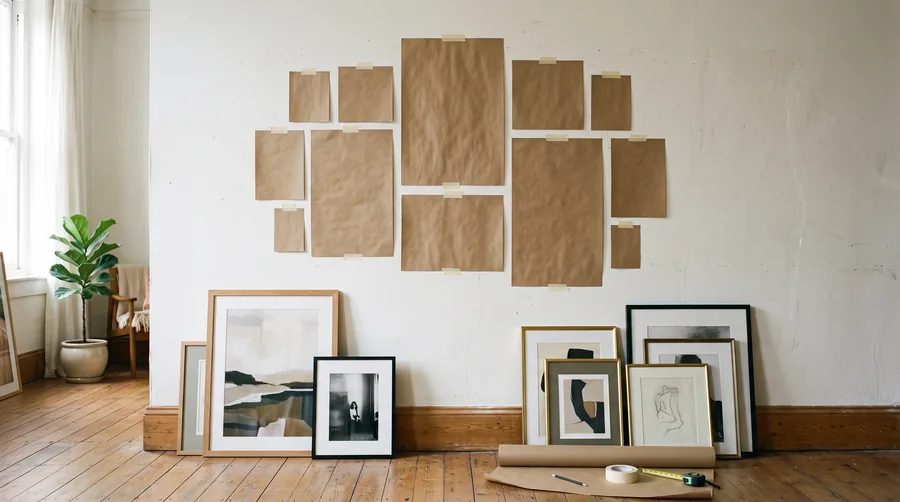
Cut a paper template for every frame, life size, and write on each what it is and where the hook falls. Arrange the templates on the floor until the cluster works, photograph it, then tape the templates to the wall with masking tape. Live with the paper for a day. Move things. Only when the paper has stopped moving does the drill come out, and then the hook goes through the mark on the paper, which is torn away afterwards. This costs an afternoon and saves a wall full of holes. The Atelier's wall planner does the same job on a screen, with your own wall dimensions and frames, and prints the layout.
Gaps and edges
Five to eight centimetres between frames, the same everywhere in a cloud. The outer edge of the cluster stays within the width of the furniture below, ideally two thirds of it, and 20 to 25 centimetres above it. In a corridor with no furniture, the cluster is centred on 150 and can run as long as the wall, provided the height stays constant: a band, not a wave.
Growing it
A gallery wall that is meant to grow needs room to grow into: leave the far side open and add there, keeping the straight edge and the rule. Or, when a new work arrives, take everything down and rehang from paper, which is faster than it sounds and is how a collection stays a composition rather than a stack. The reward is the wall people stand in front of longest in the house, reading it like a page.