Interior · Lighting
Light for Living with Art
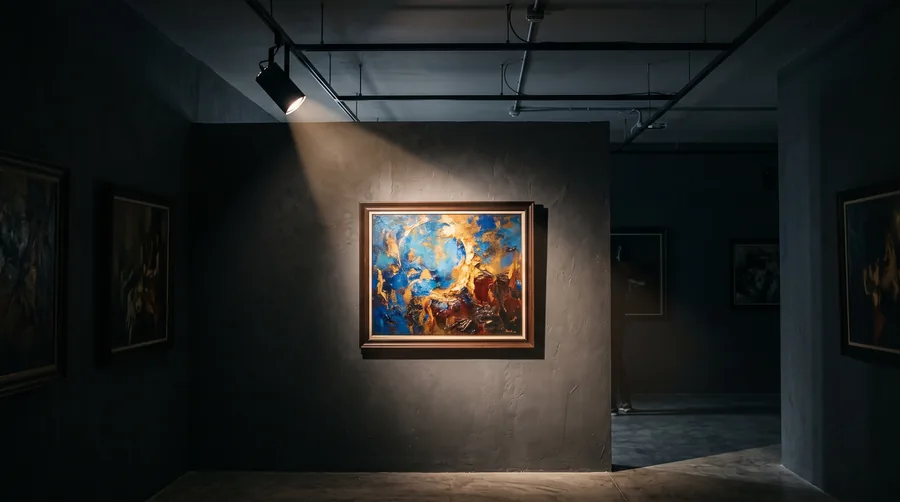
A gallery lights a painting to be seen. A home has to light it to be seen and lived with and not destroyed. Thirty degrees, ninety on the colour index, two thousand seven hundred kelvin and a dimmer.

The most common way a painting is lit at home is by accident: a ceiling fitting in the middle of the room, a window somewhere, a lamp on a side table. The painting is visible in daylight and vanishes at dusk, or worse, becomes a mirror of the lamp. A gallery would never allow it, and the rules a gallery follows are simple enough to borrow.
Thirty degrees
An accent light hits the centre of the work at about 30 degrees from the vertical. Steeper, and the frame throws a shadow down the picture and every ridge of paint stands out like a relief map. Shallower, and the glass or varnish reflects the light source back at the viewer. Thirty degrees is the angle at which a surface is lit evenly and reflections go to the floor. In practice: for a ceiling at 260 centimetres and a picture centred at 150, the spot sits about 63 centimetres out from the wall. The Atelier's light tool does the trigonometry for other ceilings.
The source
LED, always, for anything you care about. Good LEDs emit almost no ultraviolet and almost no heat, which halogen and incandescent bulbs did in quantity. The three numbers on the packet that matter: colour temperature, 2700 to 3000 kelvin for a living room; colour rendering index, 90 or higher, because a cheap LED with a CRI of 80 turns reds brown and a painting loses a third of its palette; and beam angle, 24 to 36 degrees for a picture up to a metre wide, narrower for a small object, a wide wash for a whole wall of frames.
Light is the only thing in the room that touches the painting every day. Choose it like a frame.
A lighting designer in Zurich
How much
For oil and acrylic, 150 to 200 lux at the surface is comfortable and safe. For anything on paper, textiles and photographs, 50 lux, which is dim and which is the reason drawings hang in the darker corners of good houses. Two spots on a track, dimmed, give a painting 150 lux from a normal ceiling. A picture light on the frame, the brass tube with the tilting shade, lights the top third of the picture and reflects off the rest; it is a tradition rather than a solution.
Daylight
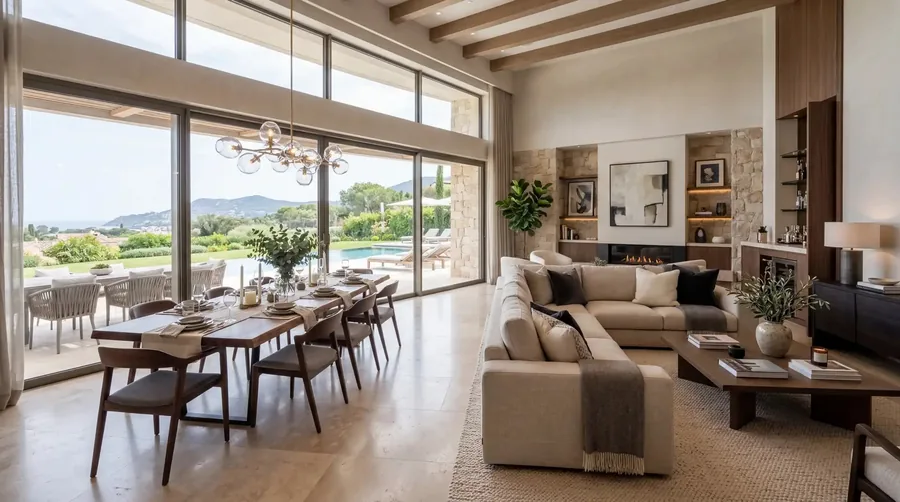
Daylight is the best light for looking and the worst for keeping. A north-facing wall receives soft indirect light all day and no sun: this is the wall for works on paper. A wall opposite a window receives the window as a reflection in every glazed frame, from noon until the blinds come down: this is the wall for a matt canvas or a relief, never for glass. A wall the sun reaches directly is for objects that do not fade, and for nothing on paper at any price.
The rest of the room
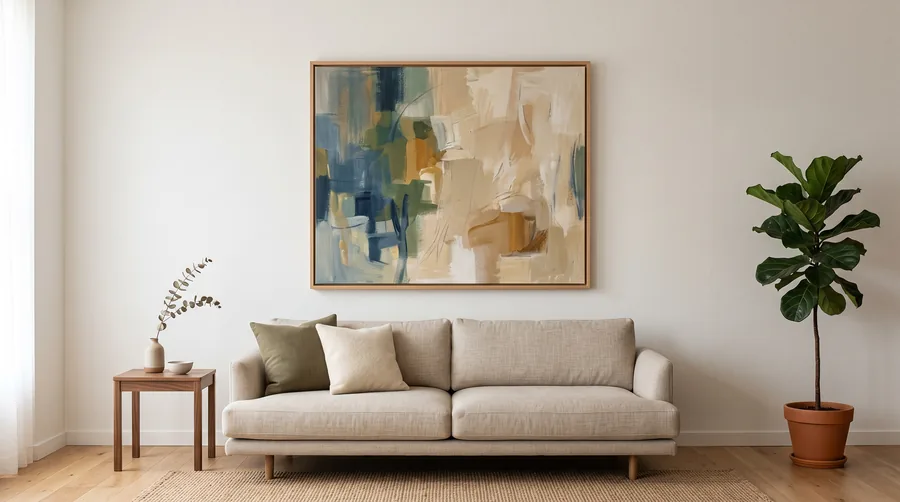
Art lighting works only if the room around it is darker than the art. A living room with every lamp on at full is a room where nothing can be accented. Layer it: ambient light low and warm, from lamps at different heights, on dimmers; task light where it is needed; accent light on the work, dimmed to a level where the painting is the brightest thing in the field of view without glaring. The result is the room people describe as atmospheric, which is simply a room where the light has a hierarchy.
Living with it
The last point is that this is a home, not a museum, and the light has to work with dinner and reading and a film. The answer is scenes: one setting of the dimmers for the evening, one for looking, one for cleaning. Smart bulbs make this trivial and a row of dimmers makes it possible by hand. What matters is that the painting is lit on purpose, which is rarer in houses than it should be and the single most visible sign that the person who lives there actually looks at what they own.