Interior · Method
How to Hang Art at Home
Most pictures in most homes hang fifteen centimetres too high, because the person on the ladder was standing up and the person who looks at them is sitting down. The 150 centimetre line fixes it. So do six more rules.
Walk into a house and look at the pictures. In nine out of ten they are hung too high, in a band that starts at about 170 centimetres and rises towards the ceiling, as if the wall were being kept clear for furniture that never came. The reason is simple: pictures are hung by a person on a ladder, at the height that looks right from a ladder. They are looked at by a person on a sofa. Galleries and museums solved this a century ago with one number.
The 150 line
The centre of the picture, not the top edge and not the hook, goes at 150 centimetres from the floor. That is average eye height for a standing adult in Europe, with a little allowance for the fact that people look slightly down. American museums use 57 to 60 inches, which is the same thing. Hang everything in a room to that line and the room reads as one composition, however different the frames.
The line moves in two cases. In a room where people mostly sit, a dining room or a snug, it comes down to 140 or even 135. Above a piece of furniture, the line is overruled by the gap to the furniture, which is the next rule.
Twenty above the furniture
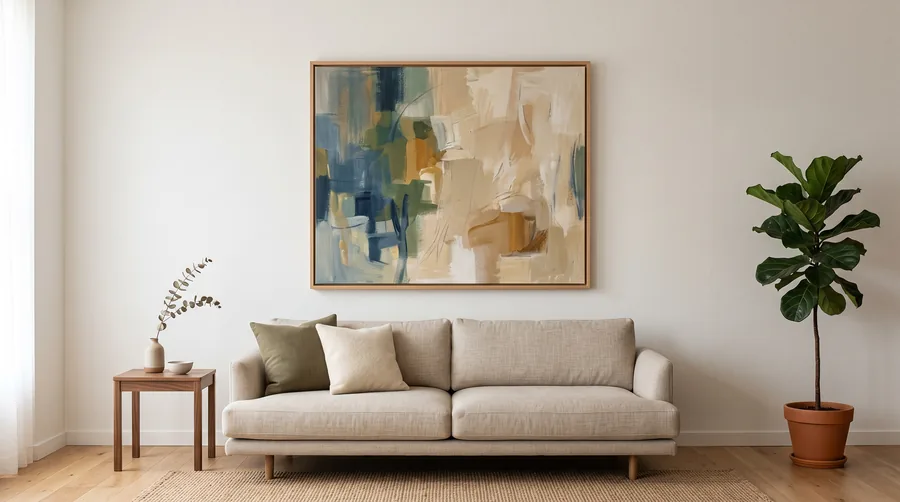
A picture above a sofa, a sideboard or a bed sits 20 to 25 centimetres above it. Closer and it belongs to the furniture; further and it floats away and looks as if it is trying to reach the ceiling. If following this rule puts the centre well above 150, follow the furniture: the gap is what the eye checks first.
Hang it ten centimetres lower than feels right. Then five more. Then stop.
A museum registrar in Basel
Two thirds
A picture above a sofa should be between half and three quarters of the sofa's width, and two thirds is the number that almost always works. A single small picture above a large sofa looks like a stamp. A picture wider than the sofa looks like a hoarding. If the one you love is too small, give it company: a pair, or a group hung as one object that together reaches two thirds. The Atelier's scale tool draws this for your own furniture.

Centre on the thing, not the wall
Pictures are centred on the furniture below them, not on the wall behind. If the sofa is off centre in the room, the picture goes off centre with it. A picture centred on a wall above a sofa that is not centred looks wrong in a way people feel but cannot name.
The hardware
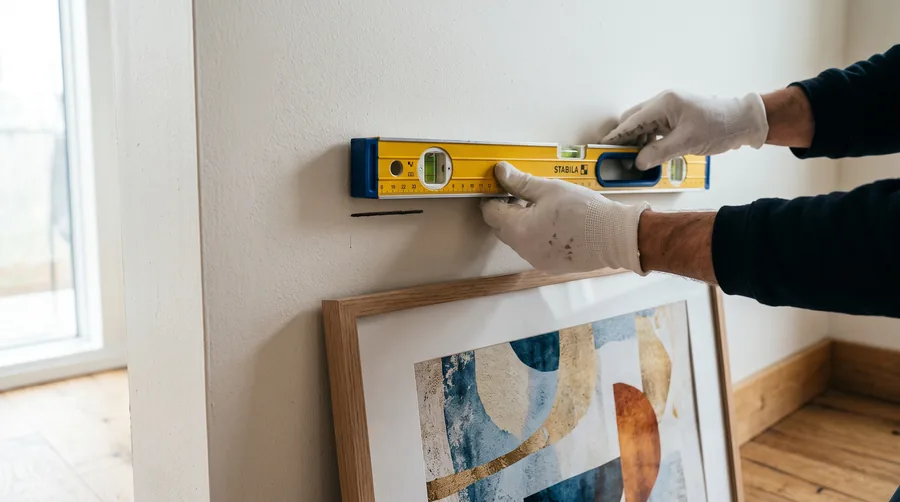
Two hooks, not one, for anything over 60 centimetres wide: a picture on a single hook rotates every time a door slams. D-rings on the frame, screwed into the sides at about a third of the height from the top, and a picture wire between them that is taut but not tight; or, better, two hooks that take the D-rings directly, which holds the picture flat and level for ever. Measure the drop from the top of the frame to the wire when it is pulled up, and subtract it from the height you want the top edge to be. That subtraction is where most people go wrong, and the hanging tool does it for you.
For heavy work, a French cleat or a picture rail system with cables, which also lets you move things without new holes. For plaster and old walls, the correct anchor rather than the hook that came in the packet.
Groups
For a group, the rule holds for the whole: the centre of the composition at 150, the outer edge at two thirds of the furniture, the gaps between frames 5 to 8 centimetres and equal everywhere. Lay the group out on the floor first, on paper templates the size of each frame, and tape the templates to the wall before drilling anything. The gallery wall story on this site takes the method further.
The last rule
Once a picture is up, leave it for a day before judging. The eye takes that long to stop comparing the new state with the old, and the picture that looked too low at lunchtime is at the right height by the following evening. If it still looks wrong after a day, it is probably the wrong picture for that wall rather than the wrong height, and that is a more interesting problem.