Design · Lighting
The Lamp Decides the Room
Furniture is what a room contains. Light is what a room is. The one object worth over-spending on is the one that is switched on after dark, and the classics of lighting are classics because they understood that.

Photograph a room at noon and at nine in the evening and you have two rooms. The furniture has not moved. What has changed is the light, and with it the size of the room, the colour of the walls, the mood of the people in it and whether the painting on the far wall exists at all. This is why the lighting designers of the last century are the true authors of modern interiors, and why the lamps on the Register outnumber the tables.
Three layers
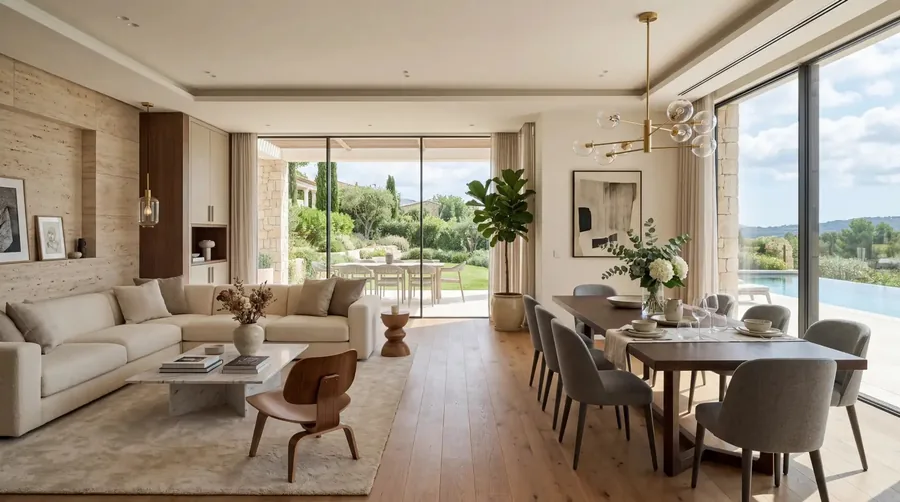
Every room that works after dark has three kinds of light, and most rooms that fail have one. Ambient light fills the volume and lets you cross the room without hitting the table; in a good room it is low, warm and comes from more than one source. Task light is aimed at the thing you are doing: the page, the chopping board, the desk. Accent light is aimed at the thing you want seen: the painting, the shelf, the plaster relief in the corner. A single ceiling fitting provides the first badly and the other two not at all.
The classics understood this
A pendant from 1958 with layered shades was designed so that no one at the table could see the bulb from any angle, and so that the light fell on the plates and the faces and nowhere else. An arched floor lamp from 1962 exists because its designer wanted a pendant over a dining table without drilling a ceiling, and it put the light exactly where a pendant would have. A desk lamp from 1972 with balanced arms conducts the current through its own structure, so there is no wire to fight and the head goes wherever the hand puts it. None of these were shapes first. They were problems solved, and the shape is what solving looked like.
Buy the furniture you can afford. Buy the lamp you cannot.
An interior designer in Milan
The numbers
Colour temperature: 2700 kelvin reads as candlelight and flatters skin, wood and warm paintings; 3000 is neutral and better for kitchens and for cool works; anything above 3500 in a living room looks like an office. Colour rendering: an index of 90 or above, without which reds go brown and a painting loses a third of its palette. Dimming: on everything, always, because a lamp that cannot be dimmed has one mood. Beam angle for accent light: 24 to 36 degrees for a painting, narrower for a small object, wider for a wall. And the rule for placing a spot: 30 degrees from the vertical to the centre of the work, which the Atelier's light tool turns into centimetres from the wall.
Light and art
A painting lit from a single bulb in the ceiling above it shows every ridge of paint as a shadow and every glazed surface as a mirror. Lit at 30 degrees from a track a metre or so out from the wall, the same painting flattens into an image and glows. Lit by daylight from a window opposite, it disappears behind its own reflection at three in the afternoon. The lamp decides whether the work is visible, and it decides for how long: works on paper want 50 lux and no ultraviolet, oil and acrylic tolerate 150 to 200, and good LEDs deliver both without heat.
The lamp as object
Because the lamp is on when the room is used, it is looked at more than any chair, and it is the object visitors remember. That is the argument for spending on it. A licensed classic from the Register, a pendant or an arc or a balanced desk lamp, costs what a good chair costs and does more for the room than any chair could. Then switch off the ceiling, turn on the lamps, and watch the room arrive.