Art · Conservation
Paper Is Afraid of Light
Drawings, prints and photographs are the works most people buy first and damage first. The damage is slow, invisible for years and permanent. Fifty lux, museum glass and a mat that costs more than you expected.
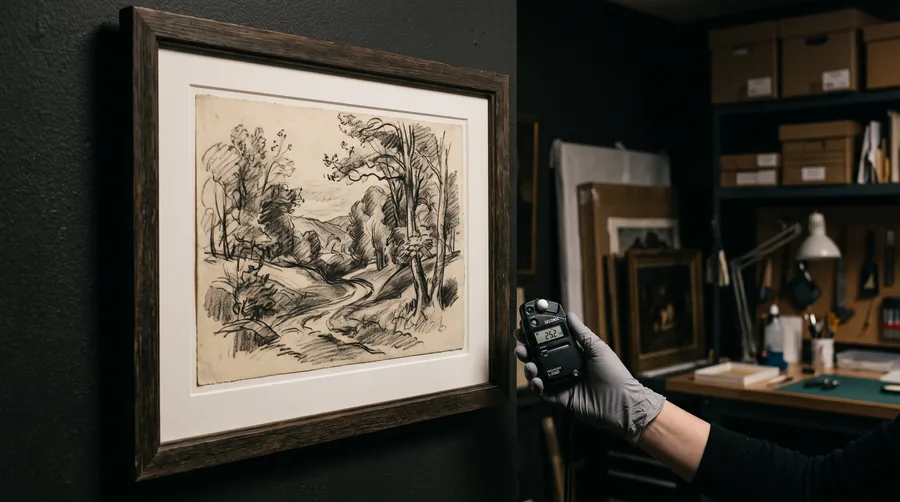
Every conservator has the same story. A collector brings in a drawing that has hung in a bright hallway for twenty years, and the conservator turns the mat over. On the back, where the board covered the edges of the sheet, the paper is the colour it was the day it left the studio. Everywhere else it has gone the colour of weak tea. The drawing is not dirty. It has been slowly cooked, and no treatment will bring the colour back.
What light does
Light degrades paper in two ways. Ultraviolet breaks the chemical bonds in cellulose and in most pigments and dyes, which is why a watercolour fades and why newsprint yellows. Visible light does the same thing more slowly, and heat from any light source accelerates both. The damage is cumulative: a drawing that receives 500 lux for one hour has taken the same dose as one that received 50 lux for ten. There is no threshold below which nothing happens, only a rate you can live with.
Museums have settled on that rate. For works on paper, textiles and photographs the guideline is 50 lux, measured at the surface of the work, and a limited number of hours a year. For oil and acrylic on canvas, 150 to 200 lux. Fifty lux is dim. It is the light of a restaurant that wants you to linger, not the light of a kitchen. Which is why museums hang drawings in the darker rooms and rotate them off the walls after a few months.
The hallway problem
Domestic light is worse than museum light in every respect: brighter, less controlled, and on for more of the day. A north-facing wall away from any window is the best a house offers. A wall opposite a window is the worst, and a wall the sun reaches directly, even for an hour in winter, should never carry paper at all. Halogen and old incandescent bulbs add heat; LEDs of good quality add almost none and emit almost no ultraviolet, which makes them the only sensible choice for lighting art at home.
Nobody thinks of a hallway as bright. Measure it at noon in June and it is a small museum with the blinds up.
A paper conservator in Munich
Glass is not glass
Between the light and the sheet there is one line of defence, and it is the glazing. Ordinary picture glass blocks almost nothing. Conservation glass filters 97 to 99 percent of ultraviolet and costs perhaps twice as much. Museum glass adds an anti-reflective coating on top of the filter, so the drawing can be seen without the room in it, and costs several times as much again. Acrylic glazing with a UV filter is lighter and safer for large sheets and for anything that will travel, though it scratches and holds static, so it should not be used over pastel or charcoal.
For anything you love, the answer is conservation glass at minimum and museum glass if the work is large or hangs where it is looked at often. The difference in price is small next to the work and invisible next to the damage.
The mat is not decoration
A mat does three jobs. It keeps the glazing off the surface of the sheet, so that condensation and static cannot reach it. It frames the image. And it is the material that touches the paper for the next fifty years, which is why it must be acid free: cotton rag board or an alpha-cellulose board with a neutral pH, not the wood-pulp board that sits in most frame-shop windows. Wood-pulp board goes brown and takes the edges of the drawing with it, producing the familiar mat burn, a tan line a centimetre inside the window.
The sheet itself should never be glued or taped. It is hinged, at the top edge only, with strips of Japanese tissue and wheat starch paste, so that it can expand and contract with humidity and can be removed by the next conservator without damage. A framer who suggests dry mounting a drawing is proposing to destroy its value in order to make it flat.
Air, water, and the rest
Light is the enemy you can see. The others are humidity, which should stay between 45 and 55 percent and above all should not swing, and heat, which speeds everything. A bathroom wall and the wall above a radiator are ruled out; so is any exterior wall in an old house with condensation. Foxing, the rust-coloured freckles on old sheets, is a combination of damp and impurities in the paper and is best treated by a conservator rather than a determined owner.
None of this should discourage anyone from buying on paper. Prints and drawings are how most collections begin, and a sheet framed properly and hung sensibly will outlive its owner without complaint. The rule is simply that the sheet is delicate and the framing is not the place to save money. The Atelier's light tool gives the numbers for your own wall; the framer gives the rest.